Goldfish Bowl Silhouette SVG
A Designer’s First Glance: Whimsy, Simplicity, and Quiet Charm
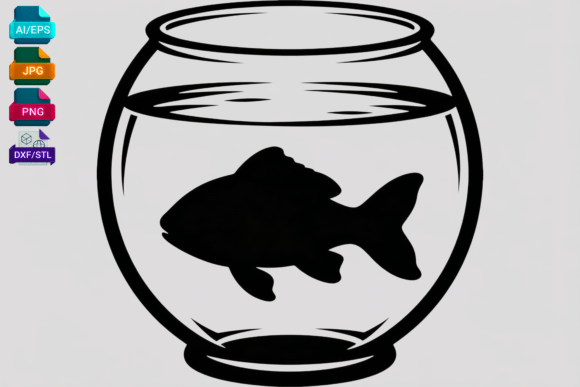
Opening the Goldfish Bowl Silhouette SVG file, I felt that familiar little lift — the kind you get when a design immediately “lands” without needing explanation. It’s not loud or trendy; it’s gently nostalgic, softly playful, and quietly confident in its minimalism. The outline is clean and fluid — no jagged edges, no overworked details — just a single continuous contour of a rounded fishbowl with a subtle curve suggesting water and a tiny, elegant goldfish mid-swim. There’s breathing room in the negative space, which tells me this wasn’t rushed. As an embroidery designer who’s stitched hundreds of silhouettes, I appreciate how thoughtfully the curves avoid tight interior corners — a huge win for satin stitch stability and thread flow.
Where This Design Naturally Lives (and Thrives)
I recently used the Goldfish Bowl Silhouette SVG to prototype a custom embroidered linen tea towel for a local boutique’s spring collection. The result? Crisp, legible, and unmistakably handmade — but never amateurish. That’s the sweet spot: it reads beautifully at 3.5 inches wide on kitchen linen, holds up on a baby onesie chest placement (with light stabilizer), and even translated well onto a structured cotton twill apron pocket. It’s especially strong for nursery decor, personalized gifts for new parents, or small-batch boutique merchandise where charm and clarity matter more than flash. Etsy sellers will find it fits right into curated listings for “gentle baby gifts,” “eco-friendly kitchen goods,” or “minimalist embroidered apparel.” It doesn’t scream — it invites. And that builds trust.
Real Embroidery Behavior: What Happens Under the Needle
In practice, the Goldfish Bowl Silhouette SVG performs like a well-rehearsed soloist: consistent, controlled, and adaptable. Because it’s a true silhouette — no internal fills, no layered elements — it stitches quickly and cleanly across fabric types. On medium-weight cotton t-shirts? Solid. On brushed cotton sweatshirts? Still clear, as long as you use a medium-cutaway stabilizer to support the gentle curves. As an applique design base, it’s ideal — the smooth perimeter makes for precise fabric placement and clean satin-stitched edges.
That said, it’s not magic. On highly textured fabrics like bouclé or thick terry cloth, the fine bowl rim can soften visually — not a flaw, just a material reality. And on stretchy knits (think lightweight jersey tees), you’ll want to double-stabilize and test hoop tension. The design has no tiny lettering or micro-details, so it avoids common pitfalls like thread nesting or skipped stitches — a real relief when managing batch orders for your craft business.
Where to Use It Thoughtfully
- Small hoop sizes: Works well down to a 4" x 4" hoop — just confirm your machine’s minimum stitch width aligns with the thinnest part of the bowl rim.
- Dark or black fabric: Choose high-contrast thread (ecru, soft white, or pale mint) — the silhouette relies on edge definition, not fill density.
- Curved surfaces (caps, hats): Scale carefully — reduce below 3" width to maintain proportion and avoid distortion on the crown.
- Frequent-wash items (baby clothes, towels, napkins): Use quality polyester thread and trim jump stitches tightly. The clean lines hold up beautifully after repeated laundering — no fraying or blurring.
Why It Elevates Your Finished Product — Beyond Just Looks
What makes the Goldfish Bowl Silhouette SVG more than just another digital file? It adds quiet intentionality. Customers don’t just see a fishbowl — they sense care, calm, and craftsmanship. That translates directly to perceived value: a $28 embroidered tote bag feels like a considered purchase, not a generic craft fair find. For small shop owners and creative entrepreneurs, that nuance builds brand consistency across products — whether it’s stitched on a pillow cover, printed in a mockup for your Etsy listing, or scaled down for a delicate patch.
I’ve watched buyers pause longer on listings featuring this kind of thoughtful simplicity. It sparks recognition (“Oh — that’s sweet!”) and emotional resonance (“Perfect for my aquarium-loving niece”). That’s engagement you can’t force with busier graphics. And because it’s rooted in classic silhouette language, it avoids dating quickly — a smart long-term asset for your design library.
Practical Notes Every Embroidery Designer Should Check
- Always test first: Stitch the Goldfish Bowl Silhouette SVG on scrap fabric matching your final project’s weight and stretch.
- Review stitch density: Even simple outlines benefit from balanced underlay — check if your digitized version includes it (if you’re converting from SVG yourself, add light running stitch underlay).
- Confirm hoop size and placement: Measure the design’s widest point — then verify it fits comfortably inside your hoop with ¼" margin.
- Inspect small details digitally: Zoom in — does the fish’s tail taper cleanly? Is the bowl’s base fully closed? These affect stitch continuity.
- Mock it both ways: Preview the embroidery file on light and dark backgrounds. Does the contrast hold? Try a black-and-white printable mockup before committing to thread colors.
- Stabilizer matters: For lightweight or sheer fabrics, use tear-away + topping; for knits, go with cut-away + light iron-on film.
- Licensing check: Since this is a Graphics product sold as a digital embroidery file, confirm whether commercial use is permitted for finished handmade products — especially if you plan to sell embroidered totes, baby items, or patches through your craft business or Etsy shop.
Final Thought: A Small Design With Real Weight
The Goldfish Bowl Silhouette SVG won’t dominate a tradeshow booth — and it shouldn’t. Its strength is subtlety with substance. It’s the kind of design that earns repeat customers because it feels personal, intentional, and quietly joyful. Whether you’re stitching a holiday gift for a teacher, building a cohesive line of nursery-themed embroidery files, or refreshing your small shop’s product photography with clean, printable mockups — this silhouette earns its place. Not as filler. But as foundation.