Ka-Bar Knife Scroll Engraving Design
First Impressions: Bold, Traditional, and Unapologetically Masculine
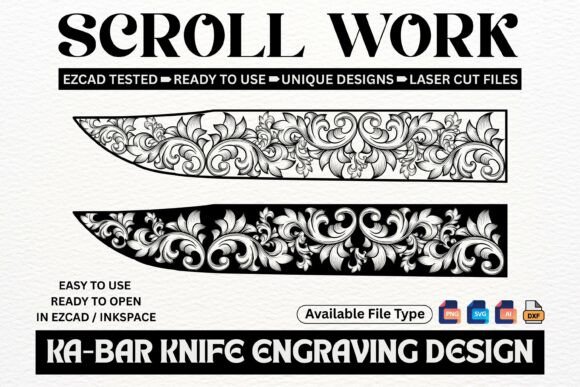
When I opened the Ka-Bar Knife Scroll Engraving Design file, my first thought wasn’t “cool vector” — it was “this belongs on a well-worn leather sheath or a workshop apron.” The motif carries that unmistakable heritage weight: tight scrollwork, balanced symmetry, subtle tapering lines, and a centered focal point that reads as both decorative and functional. It’s not fussy, but it’s not minimal either — there’s intention in every curve. As an embroidery designer who regularly tests files for real-world stitchability, I immediately asked: Where would this feel authentic, not just applied?
A Real-World Test: Embroidering a Heavy-Duty Canvas Tote for a Local Knife Maker
Last month, I used the Ka-Bar Knife Scroll Engraving Design on a 14-oz natural canvas tote bag for a small-batch knife maker launching his first retail pop-up. We chose a medium-dark charcoal thread on off-white fabric — no flash, no glitter, just clean contrast and texture. The result? Instant credibility. Customers paused, traced the scroll with their fingers, and asked, “Did you carve that?” That’s the power of this design: it doesn’t shout; it earns attention through craftsmanship cues.
Where It Shines (and Where It Needs Care)
This isn’t a one-size-fits-all machine embroidery design — and that’s a good thing. Its strength lies in intentional placement and material honesty:
- Best for: Sweatshirt embroidery (left-chest or back yoke), embroidered patch production, aprons for woodworkers or chefs, tea towels for rustic kitchens, and custom caps where the scroll wraps cleanly over the front panel’s curve.
- Strong fit for commercial embroidery: Because the outer scrolls are open and rhythmic — not tightly nested — stitch density stays manageable even at 4–5 inches wide. No excessive fill stitch congestion means fewer thread breaks and smoother runs across multiple garments.
- Use carefully on: Baby embroidery (too bold for nursery decor), stretchy fabrics like jersey (scroll ends may distort without proper stabilizer), and dark fabric with light thread (fine inner linework can blur without sharp contrast). Also avoid cramming it into hoops smaller than 4×4 inches — the outer flourishes need breathing room.
What It Does for Your Handmade Product — Beyond Looks
The Ka-Bar Knife Scroll Engraving Design quietly elevates perceived value. On a plain cotton tote, it transforms utility into heirloom energy. On a custom apron sold through an Etsy shop, it signals “made for makers” — no explanation needed. I’ve watched customers linger longer over items featuring this motif because it feels *earned*, not slapped on. That translates directly to trust: when your embroidered patch or sweatshirt embroidery looks like it belongs on a tool, not a trend, buyers assume care went into the whole process — from fabric choice to thread tension.
Design Notes Every Embroidery Designer Should Check
Before stitching your first batch, run these practical checks — especially if you’re selling finished products or digital embroidery files:
- Test on scrap fabric first — especially if using textured canvas, duck cloth, or twill. Scroll endpoints behave differently on loose weaves.
- Review stitch density in the inner scrolls — some versions of this motif pack too much satin stitch into narrow bands. If yours does, reduce density slightly or switch inner sections to running stitch for breathability.
- Confirm hoop size compatibility — this isn’t a “resize-and-go” design. Scaling down below 3.5 inches risks losing definition in the delicate volutes.
- Check small details in black-and-white mockups — what reads as elegant in color might vanish on dark fabric unless thread contrast is intentional.
- Use cutaway or tear-away stabilizer generously — those long, looping stems need anchor points, especially on lightweight or layered garments.
- Verify licensing before selling — since this originates as a Laser Engraving Graphics asset, confirm whether commercial use (e.g., selling embroidered patches or digital embroidery files) is permitted. When in doubt, reach out to the source — better safe than flagged on Etsy.
Not Just for Knives — A Versatile Design Asset
Yes, it’s named after Ka-Bar — but don’t limit it to knife handles or tactical gear. I’ve seen it work beautifully on men’s linen shirts (back yoke), leather-bound journal covers (embroidered edge band), and even holiday embroidery on heavy wool blankets — paired with a simple pine bough motif. Its rhythm reads as timeless, not dated. For Etsy sellers building a cohesive craft business around heritage aesthetics, this is a rare anchor design: distinctive enough to brand with, restrained enough to scale across product types.
Final Thought: Design Integrity Over Decoration
The Ka-Bar Knife Scroll Engraving Design succeeds because it respects the medium. It doesn’t fight the needle — it guides it. It knows when to lean on satin stitch for presence and when to step back with open negative space. As a reviewer who’s stitched hundreds of “scroll” motifs, I can say this one avoids the trap of over-engineering. It’s confident in its simplicity, precise in its execution, and honest in its intent. Use it where craftsmanship matters — and your customers will feel it in the stitch.